Mazi Nwonwu's blog
Friday, February 3, 2012
Occupy Nigeria: Sustaining the momentum
The fuel subsidy protests have come and gone. The dead have probably been buried, with only the pain, deeply etched on the heart of mothers, siblings and others connected to the deceased, left to mark their passing. Whatever the circumstance of their passing, the sacrifice of those martyrs that fell to the bullets of their own police force is great; greater even, than many may care to know. For upon the blood of these ones, Nigerians laid a foundation for a future that may well be bright.
While death, injury and perhaps permanent handicap to some victims can be said to be prominent among the things that the Occupy Nigeria Movement would be remembered for, they are by no means the only ones.
continue reading here
Labels:
Nigeria,
Occupy Nigeria
| Reactions: |
Friday, January 27, 2012
What Mr President should do
| Image via Wikipedia |
I have always felt Goodluck Ebele Jonathan might be the wrong sort of president for Nigeria.
The peculiarities of the Nigerian experience, I felt, are too diverse and complex to be left in the care of a man whose past experiences show that he lacks the kind of strong will leadership of a country like Nigeria so clearly needs.
My misgiving about the man and his antecedents was shared by many, but our numbers were not enough to keep him from winning a largely free and fair election.
Those misgivings of mine have proven to be justified, as he seems not to realise the enormous power he wields as president of a regional super power. He has tried to act, but only succeeds in appearing more helpless to stop Nigeria’s gradual slide to anarchy.
Truth be told, President Jonathan did not cause much of the problem he is saddled with now. It has been said that the man means well for the country and has himself said it is his desire to leave the country better than he met it. He has even, a first for Nigeria, declared that he will not run for a second term.
Perhaps the man may go on to become successful as a president all the same; perhaps his self-professed good intentions will become clear to Nigerians. While all that reside in the realm of speculation, what is clear is that Nigerians are largely unhappy with their president.
Even those who still hang on to the notion of him being a messiah with a divine mandate to rescue Nigeria feel Goodluck Jonathan is missing in action, though they believe his failure for effective leadership stems from the fact that he had surrounded himself with the wrong sort of people.
On Friday, January 20, 2012, Boko Haram fighters overran Kano and held the ancient city to ransom for hours on end. They killed hundreds, destroyed properties, threw the populace into a heightened state of panic and disappeared.
The attack was a new angle to the ever-shifting Boko Haram mode of operation, a new vista of the reach and bloodlust of a sect whose insurgency have been said to have started as a localised conflict between them and allegedly heavy-handed police officers.
While it would not be right to blame the president for the acts of a sect that has defied coherent definition and who have rebuffed every call for dialogue, it is right to blame him for not doing enough to safeguard Nigerians within the borders of a country that is the regional power broker.
Why him? Some may ask.
Well, because he is the president and the buck stops smack on his extra-large desk.
So far, Jonathan’s media managers have made a very big mess of the simple job of reading the mood of the nation and making sure the president understands it and articulates the right kind of response. Perhaps they misunderstand the issues themselves or are still caught up in that stale system of governance that underestimates the intelligence quotient of the average Nigerian.
Examples of these gaffes abound, whether we look at the erstwhile-celebrated presidential spokesperson Reuben Abati’s insult in the face of the Kano carnage (“seven people dead” he said, when the body count is in hundreds) or the attempt by Information Minister Labaran Maku and co to sell the fuel subsidy bullshit to Nigerians.
I understand what Goodluck Jonathan is facing, maybe just a little but that should suffice here. I know how difficult it is for one to function effectively as a leader when people who feel they are your superior intellectually and those who may have played big roles in ensuring your electoral victory surround you. It is worse when the wishes of those “powers” differ from yours and when hurting them may spell more trouble than you can handle.
The president needs to understand that no matter the route he took to get to where he is now, no matter the role played by any individual, he is there and that is the status quo. The nature of that position places him above everyone else, as he is the lord of the land until the next election. He wields enormous powers; he is in charge and should be seen to be thus. The only people he needs to answer to are the Nigerian people.
Going forward, the president needs to take more proactive measures, seek advice beyond the traditional channels.
He needs to, as a matter of urgency, suspend the Minister for Petroleum and ensure investigations into that rotten-through sector, which remains the mainstay of the Nigerian economy and the centre of corruption.
He needs to start a process that will overhaul the nation’s security apparatus, moving them from job creation agencies to the professional bodies they should rightfully be. Besides there are too many uniforms in Nigeria, all doing the very same thing.
Bottom-line, Nigeria is in dire need of a comprehensive overhaul, and Goodluck Jonathan should be man enough to begin the process. Let us for the first time in its history see Nigeria work right.
This is a version of my article on Jonathan's failings as a leader published by Daily Times Nigeria here
For the raw, uncut and lengthier version, go here
Related articles
- Is Boko Haram Enjoying Goodluck? (olaoluwabimibola.wordpress.com)
- why jonathan will struggle to combat boko haram (africaforinvestormouth.wordpress.com)
- North Nigeria police station overrun in sect attack (ctv.ca)

Labels:
Fuel Subsidy,
Goodluck Jonathan,
Governance in Nigeria,
Islamic fundamentalisim,
Nigerian Bombings
| Reactions: |
Saturday, January 21, 2012
Mr Goodluck; please be the President!
| Image via Wikipedia |
Check out the BH rubbish; where he danced to the tunes of technocrats who kept lying to him that the Nigerian security agencies, already compromised by years of unchecked corruption, can effectively handle the insurgency their heavy-handed approach caused in the first place.
While I condole with the families of the hundreds of Nigerians sent to an early grave by Boko Haram and the Police, I say we do not forget where all these evil stem from: Bad leadership, corruption, poverty and a security force that is seen first as a job creation unit for jobless Nigerians, and where tribe and region plays an important role in ensuring one is recruited.
Goodluck Ebele Jonathan has to be a Nigerian president. He has to stand firm and exude confidence. He needs to wake up to his real responsibility. I don't believe an OBJ or a Buhari would be in this mess now. GEJ appears to respect people he thinks are better than him too much. One time he was differing to Adebayo, another time it was Obama, then Dangote, etc. He needs to realise that he is the PRESIDENT, THE NUMBER ONE. Every other Nigerian, no matter how rich or powerful, is under him and should be subject to his command. He needs to realise that he actually has the power and begin to use it sensibly.
These thoughts are from my facebook post
Related articles
- Boko Haram Leader Vows More Attacks On Christians | Jih@d (theromangate.wordpress.com)
- One Blast Too Many (yomzie.wordpress.com)
| Reactions: |
Monday, January 16, 2012
Fashola's speech, as the army invaded Lagos
| Image via Wikipedia |
Dear Lagosians,
For the past few days, I have monitored the developments related to the public protest against the increase in the pump price of petrol.
During that period, I have at the invitation of my colleagues in the Governor’s Forum responded to an invitation from the Presidency.
My role since last Monday till date has been to find a ground of compromise that stabilizes the polity, protects our democracy and prevent any loss of lives.
Inspite of these efforts, we were not wholly successful in preventing the loss of the life of a young Nigerian, AdemolaAderinto who was sadly shot.
I am truly saddened by that ugly development. While I condole with his family, I pledge the commitment of our Government to bring the alleged perpetrator to justice.
I have decided to address you today in view of the very disquieting developments that occurred overnight especially the deployment of soldiers across Lagos.
I have the highest respect for members of our military, especially because they have made a contract with all of us that they will willingly lay down their lives whenever it becomes necessary to do so, in order to protect us.
This covenant is instructive, because soldiers did not sign up to stop us from expressing our grievance about things that we are displeased about.
It is not disputable that the citizens who have gathered in several parts of Lagos like Falomo, Ikorodu and Ojota to mention a few have largely conducted themselves peacefully, singing and dancing while they expressed their displeasure at the way that we have taken decisions that affect them.
That in my view should not offend those of us in Government. The majority of these people who represent diverse interests have not broken any law. If they have, it is my opinion that in a constitutional democracy, it is the police that hasthe responsibility for restoring law and order if civil protests threatens the breach of the peace.
This is not justification for sending out soldiers to a gathering of unarmed citizens. Every one of us, or at least majority of us who hold public office danced and sang before these same people when we were seeking their votes.
Why should we feel irritated when they sing and dance in protest against what we have done?
For me this is not a matter for the military. The sooner we rethink and rescind this decision the better and stronger our democracy will be.
If anything, this is a most welcome transformation of our democracy in the sense that it provokes a discussion of economic policies and this inevitably may result in political debate.
I therefore urge the reconsideration of the decision to deploy soldiers and implore the President and Commander-in-Chief to direct their withdrawal from our streets, I must also emphasize that the rights of free speech and protest is not absolute. They impose the duty not to break the law, breach the peace, endanger human life or destroy property whether public or private.
They also impose the duty to respect the rights of others not to support our protest and indeed to support what we oppose. At the end of the day, it is a contest of ideas in which the most persuasive will get the endorsement of the majority of the people we serve.
I am convinced that our democracy is mature enough to accommodate this. We must do our best to ensure that it does.
God bless you all.
BabatundeRajiFashola, SAN
Governor of Lagos State
Monday, January 16, 2012
Labels:
Fashola,
lagos,
Military occuption
| Reactions: |
Friday, January 13, 2012
The Inheritors (#occupy Nigeria)
They walk in death's shadow
The evil they should've feared
live within their hearts
Bidding them heed darkness residing inside
The gun is their strength
Through it our is obeisance is obtained
As they rampage through this valley
Before them we stand
Trembling hearts caught
In-between chattering dental
Bladder loosened by fright
Body taut in heartless readiness
waiting for hot lead to strike
Do they not laugh?
Teeth sparkling ever thus
Behind tinted glasses they slyly cough
As hunger pushes us towards them
in servitude
They know not the gods' name
Therefore, beseech them in vain
They hearken only to their hate
That hunger that knows no sate
Their god is money
We know their oppression
Is only for this while
We hoped for death's call
Its call whispered song
For them, not us
Alas, we hoped in vain for
Fate holds back our saving rain
They knew death's name' thus
Planned all along to cheat him
did they
When their progeny return
from across the sea where they're groomed
Away from empty classrooms where
They hoped to keep us blind and doomed
While theirs seek the light
Alcoholics and addicts
Infused with ways foreign
Speaking white tongue whitely
Speaking ours strangely
If they speak at all
Our culture repulses them
Our dances bemuses them
Their roots cut off
Replanted in cities far away
To them it's said our future is given
To carry our flag, write our laws,
Fight our wars, and rule our land.
To them, for who we are
Another piece of inheritance
Our land is bequeathed
live within their hearts
Bidding them heed darkness residing inside
The gun is their strength
Through it our is obeisance is obtained
As they rampage through this valley
Before them we stand
Trembling hearts caught
In-between chattering dental
Bladder loosened by fright
Body taut in heartless readiness
waiting for hot lead to strike
Do they not laugh?
Teeth sparkling ever thus
Behind tinted glasses they slyly cough
As hunger pushes us towards them
in servitude
They know not the gods' name
Therefore, beseech them in vain
They hearken only to their hate
That hunger that knows no sate
Their god is money
We know their oppression
Is only for this while
We hoped for death's call
Its call whispered song
For them, not us
Alas, we hoped in vain for
Fate holds back our saving rain
They knew death's name' thus
Planned all along to cheat him
did they
When their progeny return
from across the sea where they're groomed
Away from empty classrooms where
They hoped to keep us blind and doomed
While theirs seek the light
Alcoholics and addicts
Infused with ways foreign
Speaking white tongue whitely
Speaking ours strangely
If they speak at all
Our culture repulses them
Our dances bemuses them
Their roots cut off
Replanted in cities far away
To them it's said our future is given
To carry our flag, write our laws,
Fight our wars, and rule our land.
To them, for who we are
Another piece of inheritance
Our land is bequeathed
| Reactions: |
Wednesday, January 11, 2012
Occupy Nigeria Jan 9 2012 @ Gani Park Ojota, Lagos
| Reactions: |
Sunday, January 8, 2012
Why I am occupying Nigeria
This is a rant, with which I aim to show how the governance
of Nigeria has personally affected me and why I do not have faith in our
so-called leaders.
I never expected that a time would come when I would have to
explain why I am against the government that runs my country. This is because
since I got old enough to analyse and understand what governance is all about,
I have not found a Nigerian government that I can wholeheartedly say I am in
total support of.
Even as a child, I saw many of the people that purportedly
lead us for what they were—selfish men and women who are more concerned about
the size of their bank balance than the diminishing returns that has
characterised the country for years. From my first vote, cast in the 1999
presidential elections that brought in Olusegun Obasanjo, I have continuously
voted against PDP and its band of nation wreckers. In other words, I have
always been part of those that occupied the mindset that until we do away with
PDP and any politician that have had lengthy involvement with that party, the
nation will continue with the downward spiral.
I boldly stand this ground today, occupying and unwilling to
back down, because the history of this country and my experience as a patriotic
law abiding Nigerian is riff with examples of how insincere and roguishly
criminal people in government can be.
As a child, visiting my grandmother in the foot hills of
Obeagu, Awgu LGA, Enugu state, the songs of otanishi—a play of the word
austerity using an Igbo word that loosely translates as head-biting, or a sting
to the head, referencing the austerity measures introduced by the Shagari
administration—was one of the lasting memories I took away. The refrain of
“otanishi egbu’go anyi o, ka’anyi’changie shagari o, o ’iwe di anyi na obi,
iwe!—austerity has killed us, let’s change Shagari, anger is in our hearts,
anger” rings in my head to this day.
As a kid attending primary school in Kaduna during the heady
IBB days, I still recall the much-vaunted structural adjustment program (SAP)
and how it was supposed to only bite for a while, but the bite lasted longer than
was promised and continues to this day.
Even though still just a child in 1993, I still remember
with pride how my dad and his friends would argue endlessly about the merits of
an MKO presidency and how SAP will finally be laid to a well-deserved rest.
Well, what happened to that expectation is well documented and Nigerians continued
the speculations of my father and his friends to this day.
For decades, I heard promises of reform that never
materialised; promises of good life that still eludes us; promises of increased
opportunity that goes no further than the vile mouth that issues them; promises
of better education in the face of increasingly ridiculous and never actualised
education policies, and can’t help but snicker at the promise of a coming magic
year that constantly kept being officially moved forward as each one loomed.
While sitting on the floor, in primary school, listening to
a teacher chalk away at the ancient blackboard in Army Children School New Cantonment
“A”, I exactly believed that was how life was meant to be, that sitting on the
floor is normal and that that it is our lot. I thought so, even though the
Command Children School that shared the same compound, and which two of my
siblings—using my dad’s old army ID and resultant quota—were fortunate to
attend, had desks, better-dressed students who eat cake at break time and more
teachers. I thought so because I felt Command Children School and others like
it were for academically gifted children who needed more care than we do.
Anyway, even the Command Children Schools of those days were not too much
removed from us—aside from having more desks and those juicy cakes, yes I tasted
them for my now late brother used to sneak into our zinc and wood classroom to
share with me.
True we saw standard classrooms in the few movies we got to
watch and in Sesame Street, but that was another life, one of fantasy, one that
belonged to the TVs we escape to at 4pm. I also felt there was nothing wrong
with there being two sections of the same school, one for morning, and another
for afternoon. Yeah, Command Children
School had only one morning section, but that was ok, they are more brilliant
kids, they don’t need to go to school under the morning sun. Can’t remember
much what I learnt in primary school, other than the best way to play dead
during the game of police and thief. Mind you, I learnt to read and write from
my father, who also taught me elementary mathematics, and much of what I know
about maths to this day.
Secondary School was worse; I got to go to Government
College Kaduna, a very popular secondary school renowned for its past glory because
my father could not afford the better private ones that were just then
beginning to spring up.
There, the sitting on bare floors was worse, especially with
our uniform being white on white. We also had to go to school in the afternoon,
at least those of us in the junior section had to. The memories I have of junior
secondary school were of not having teachers and spending the day playing fives
or shooting pigeons with catapults in the school’s extensive vegetation. Yeah,
the chairs did come—think I was in JSS 2 then—from Buhari and other alumni. As
for teachers, nothing changed until we entered SS 1, extremely under-educated
and most barely able to string English words together without blunders. I must
add that we had no teacher for mathematics and English the entire duration of
our Junior Secondary miss-Education.
I was lucky; yes, I was, for I had inherited the love for
books from my father and a fight, its resultant punishment and a kindly
librarian who supervised the dusty task of sweeping the school library
introduced me to a world far removed from the one I know. I began reading,
garnered knowledge on my own and managed to make the best out of a very bad
situation. I was not alone in this, and those of us who learnt anything from
Government College Kaduna, did so on our own.
Then came the battle to enter university, a mighty struggle
for us half-baked secondary school graduates. We struggled, paid for extra
lessons and read until our eyes watered until the university doors opened and
swallowed us. Back then examination malpractice in the form that it is today
was the preserve of those who can afford it and you only steal from those you
feel know more than you, unfortunately, I fell into the group that were
presumed to know, so I didn’t get to steal from anyone.
My stay in the university was marked by increase in school
fees. I got admitted in 1999 and paid N1600 (one thousand six hundred naira) as
a fresher, by the time I left five years later in 2004, school fees was N17,
500 (seventeen thousand five hundred Naira). Math understandably never became
my thing, so let someone else do the maths on percentage increase over a four-year
period. I can’t recall how many strikes from the Academic Staff Union of
Universities occurred while I was an under-educated undergraduate, but I know
it was enough to add an extra year to my four course.
The story of how I eventually got a job and the struggles
and anguish in between will be better told in the future, but the fact that as
an editor of a magazine and with a salary many times over the recently reviewed
minimum wage, I still find it very impossible to survive month to month. I
don’t have vices and have learnt from my years of struggle to respect money,
yet I can’t afford a tokunbo car on my salary or a house big enough for my
family, not to talk of taking proper care of them.
I am a half-baked Nigerian graduate, all my life the
Nigerian government has not shown it cared I exist or that I have a stake in
this country they claim is ours. Therefore, until I am assured that my children
will not pass through the same hard route I did to get here, I shall continue
to occupy.
Related articles
- Day Two of Subsidy Removal Protest - Cities Round Up (ogala.wordpress.com)
- Kano Finds Religious Unity In Subsidy Protest (ogala.wordpress.com)
- Protesters in Kaduna denounce fuel price increment (vanguardngr.com)
- Counting the cost of a Greek gift (vanguardngr.com)
- Subsidy Removal: We 'll continue to say NO! - Nigerians vow (vanguardngr.com)
- Fuel subsidy protest spreads through cities: one killed in Ilorin, another shot in Lokoja (saferafricagroup.com)
Labels:
austerity measures,
Fuel Subsidy,
Goodluck Jonathan,
Hard Times,
Nigerian leadership,
Occupy Nigeria,
SAP
| Reactions: |
Wednesday, January 4, 2012
Joint Communiqué of the Emergency Meeting of the National Executive Councils of the Nigeria Labour Congress (NLC) and Trade Union Congress (TUC) Held on Wednesday 4th January, 2012.
The National Executive Councils of the Nigeria Labour Congress (NLC) and the Trade Union Congress (TUC) took place today, Wednesday 4th January, 2012.
The NLC and TUC noted that:
The Presidency announced the removal of petroleum subsidy and adjusted upward, the pump price of petrol on 1st January, 2012 even when it claimed it was consulting Nigerians.
Due to this upward review of prices, the pump price for petrol is now selling for between N141 and N200 per litre nation-wide rather than N65. This prohibitive increase in price of PMS once again confirms the position of Labour that deregulation to this government means incessant price increase of a strategic product (petrol) that impact on cost of living, cost of production and the general well-being of increasingly impoverish Nigerians.
The immediate generalized negative impact of this price increase on transport cost, food, drugs, schools fees, rents, indicate that government is totally wrong to underestimate the impact assessment of the so-called deregulation policy.
Due to the untoward hardship workers and other Nigerians are experiencing based on excessive increase in petrol prices, there have been sporadic protests by Nigerians in at least 10 cities;
These protests, which are peaceful have witnessed the use of unprecedented force by the Police leading to harassment, intimidation, arrests and the murder of a protester.
There is a subsisting understanding between Congress and the Federal government in 2009 that removal of subsidy will not commence until certain conditions have been met. These include the fixing of all the refineries and building new ones, regular power supply, and provision of other social infrastructure such as railways and repairs of roads as well as eliminating the corruption associated with supply and distribution of petroleum products in the downstream sector of the oil industry;
After exhaustive deliberations and consultations with all sections of the populace, the NLC, TUC and their pro-people allies demand that the Presidency immediately reverses fuel prices to N65. If the Government fails to do so, they direct that indefinite general strikes, mass rallies and street protests be held across the country with effect from Monday 9th January, 2012.
From that Monday, 9th January 2012 date, all offices, oil production centres, air and sea ports, fuel stations, markets, banks, amongst others will be shut down.
We advise Nigerians to stockpile basic needs especially food and water.
We call on all Nigerians to participate actively in this movement to rescue our country. The emphasis is on peaceful protests, rallies and strikes while refusing to be intimidated. Labour calls on the police, armed forces and other security agencies to reject orders that they turn their weapons on fellow Nigerians. We warn that anybody who does so, will be individually brought to justice.
The primary objective of this patriotic call and movement is to revert PMS price to N65, restore normalcy and reclaim Nigeria for Nigerians.
No Retreat!
No Surrender!!
Forward Ever!!!
Abdulwahed I. Omar Peter Esele
President, NLC President, TUC
Related articles
- Subsidy Removal: NLC, TUC to organise national strike (vanguardngr.com)
- Subsidy Removal : Labour leaders meet tomorrow on strike date (vanguardngr.com)
- NIGERIA UPDATE: Oil Subsidy Removal (nigeriaenergyintelligence.wordpress.com)
- Fuel subsidy removal: Prepare for a showdown, NLC, TUC tell Nigerians (vanguardngr.com)
Labels:
Fuel Subsidy,
Governance in Nigeria,
Nigeria,
NLC,
TUC
| Reactions: |
Tuesday, January 3, 2012
Badluck for Nigeria
| Reactions: |
Africa: Benefiting From The Tablet Wars
Light weight, portable, convenient, ultra-mobile and sleek are some of the adjectives that have been used to qualify the recent gizmo fad among techies -- the Tablet computer. Tablet computers are a cross between a laptop and a mobile phone, offering all or some of the features of both devices.
Tablet devices, especially Apple’s iPad, took the world by storm and is presently the topmost must-have device among the business class and technologically perceptive individuals. Initially, with much of the tablet computers in the market selling for over $300, many who would have loved to switch to the new technology considered the price prohibitive.
However, with the launch of Amazon Inc’s Kindle Fire, which retails at a mass market friendly $199; most analysts have begun predicting a drastic fall in the price of tablets as competition heats up. Lower prices will ultimately lead to desirability-fuelled purchases, especially in the west where there is already very high penetration of smart phones and laptop computers.
In truth, much of the analyses around Tablet computer market performances have been done without recourse to the African market. As market projections focuses on the Asian, European, South American and US markets, not many people are looking at how much of an impact the pocket friendly Kindle Fire and its kind would have on the ever growing African Phone and computer market.
Jumping the technological divide
While the present market of tablet computers in Africa is centred on middle class professionals and business executives, there exists a vast market that decreasing prices will in time open up.
Thankfully, everyone is now aware of African mobile telephone revolution, which saw more people in the continent connected to telephones in the last decade than the whole of the preceding century. Presently, Africa is unarguably the fastest-growing mobile phone market in the world.
According to statistics from the International telecommunication Union (ITU), with an annual growth rate of 65 per cent, Africa’s mobile telephone subscription grows at twice the global average. The continent is also the first place where mobile connections superseded that of fixed line connections. The reason for this is not farfetched as prevailing financial downturn in many African states makes mobile technology a cheaper alternative to conventional telephone that requires telephone cables, poles and many other facilities to function. By adopting mobile technology, African states succeeded in not only making it easier for their citizens to access the pleasures of information technology, they also successfully bridged the information divide by jumping the large gap between it and advanced societies.
In Nigeria, South Africa and others, the progresses made as a result of mobile technology is immense and the potential market for mobile phones is still enormous, however, the question might be asked about the validity of claims that Africa may become one of the top market for tablets computers. Respondents, looking at the status of the purchasing power of the average African, might answer in the negative, but with reference to the mobile phone and how easily the technology was adopted across the continent, a more positive answer would readily come to mind.
Power saving, portability are factors
Looking closely at the African market, one would find that given a choice between a laptop computer and a desktop computer, most tech savvy people would go for the laptop. Yes, portability is a catalyst, but so also is the fact that the laptop comes with a rechargeable battery that allows users to work for hours on stored power.
Power is still a very critical issue across the African continent and the nature of tablet computers, the fact that they have the power storage ability of the mobile phone and laptops, is a top selling point.
It is instructive to note that that same factor that enabled consumers in Africa to extensively adopt mobile phones would also play a part in the incursion of tablet computers. With the average tablet computer having more portability than any laptop computer in the market, while retaining all of the laptops ability, there is no gainsaying that fact that most buyers would consider it a better option than the laptop.
Therefore, it would make very good business sense for manufacturers to key into the African market and take advantage of the millions of users who are seeking a portable device that can grant them all the technology of the mobile phone and the laptop computer.
What to watch out for
Unlike what holds in the developed world, where desirability plays a greater factor in the tablet market than need, the African market is overflowing with first-time buyers for whom the choice would be a matter of price and practicability.
With 3G penetration still at a very low percentage across Africa, sensory and technological aspects of tablets need not be a major issue. It is a given that tablet computers may have to be tailor made for the African environment, especially by paying close attention to the following details.
Power: a longer lasting battery would be of great attraction due to the endemic power outages that remain the norm in many African countries.
Price: while it is true that many people across the continent are buying high-end phones, much of the population are concentrating on the more affordable entry-level versions, or buying second-hand phones imported from Europe, the Americas and Asia. For the ready market for tablet computers to be effectively harnessed, the prices of the device must be reduced drastically, even lower than Amazon’s low priced Kindle Fire.
Scaled down versions: reduction of prices might be a hard nut to crack for tablet computer makers who have had to invest a lot of resources on research and development, but like Amazon did with Kindle Fire, scaling down the devices by removing some features might do the trick. The key is the billions of people in Africa eagerly awaiting connection to telephone lines and consequently, the internet.
Specialised adaptations: while it may make sense to remove features that may be redundant in Africa, it also makes better sense to include practicable features. For example, Nokia reported that the inclusion of a flashlight, FM radio and local language options pushed sales of entry-levels in many African countries.
Though, at present, content might be overrated or negated by very slow internet speed, the berthing of more submarine cables and the connection of that to the growing number of fibre optic cables between cities in Africa means that will remain an issue for long. Something that manufacturers should pay heed to.
Most importantly, there is a need for manufacturers to commit recourses into researching the African market and coming up with advertisement policies that will better sell their products to the millions of potential customers in Africa, especially now that the question of whether there is a ready market for information technology in the continent have been answered.
By Mazi Nwonwu
Article previously published in Business in Africa magazine www.bizinafrica.biz
Related articles
- What Features Will Future Mobile Phones Most Likely Have? [Geeks Weigh In] (makeuseof.com)
- Is 2012 the year for India's internet? (InnovationToronto.com)
- The worst tablet computers released in 2011 (sfgate.com)
- Mobile shoppers snap up bargains (guardian.co.uk)
- Tablet computers: Sony Tablet S now $100 cheaper (csmonitor.com)
- 300 Million People access Facebook via Mobiles (mobigyaan.com)
- Nokia 'does not have an exact plan' on tablet launches, says Elop (thenextweb.com)
Saturday, December 31, 2011
What's in a name?
First off, I stole this title from an article by writer,
blogger and radio presenter Tosyn Bucknor. In said article, published in
Guardian some years back, Miss Bucknor explored the strength of names, and how those
endowed with instantly recognisable names, especially when said names carry a
mark of fame or the fragrance of serious money, find locked doors opening with the
ease obtainable from well-oiled hinges.
It wasn’t that Miss Bucknor put it in the way I just did, that
is just my perculiar summary.
Anyway, I stole the title. I did so because it addresses
very much an issue that bothered me for a long—the fact that I did not pay the
right kind of attention to my identity and how the name I bear takes away from who I am.
I was born Igbo, in a village health centre in the very small
town of Nkwe, which nestles proudly atop a flat-topped hill in Anike, Awgu LGA,
Enugu state, South Eastern Nigeria. My parents professed Christianity and as
such saddled me with what they and the priests called “English Name”.
Here, English names have for long been regarded as of utmost
importance if you are to be accepted into the fellowship of the brethren—something
that is supposed to be the highest rank one can attain, and a mark of possessing
the Christian faith. Therefore, to gain acceptance as a follower of Christ, as
a baby I was christened with the German name Fredrick. Don’t ask me how a
medieval German name became an English or Christian name—ask the church people
instead. I am sure my mother did not know what the name meant and my father
insisted for years that Alfred was what he asked the Catchiest to christen me
with. This however, wasn’t an issue as my family, like many from these parts,
cared little for the name after the church ceremony and called me by my native
name Chiagozie—a richer, more endearing name than that German one.
I remember forgetting that my name was Fredrick until I began
primary school (Kindergarten was a long dream only the very rich dreamt about
in those days) and was asked to bring my baptismal card for age verification.
Suddenly I found myself answering to Fredrick in School and
my native birth name—mostly its abbreviates, Agozie or Ago—at home. I must confess
that as a child, I rather liked my “English” name and smiled at the prospect of
being addressed thus whenever a friend visited me at home. I dreamt of dumping
the native sounding Agozie entirely and adopting Fredrick, surnamed with a
funkier anglicised version of my surname, for both school communal usage.
Thank the gods for getting older and finding emancipation.
Now I see the folly of cleaving to a name that does not define me in any way.
Yes, I found out in secondary school that Fredrick means peacefully ruler. I
agree that I am naturally peaceful, but I do not rule over any kingdom, so go
figure.
For a name, I believe one should cleave to that which best
identifies his demography. Why should I, an Igbo man, contend with a German
name. What has Germany done for my motherland or me. I do agree that in the
future, if I meet a Fredrick that seriously impacts my life, I wouldn’t mind
naming a son or grandson after him, but for now I can only Answer that
question, WHAT’S IS IN A NAME?
EVERYTHING, I say.
That said, let’s bid farewell to Fredrick Chiagozie Nwonwu and welcome from obscurity Mazi Chiagozie Nwonwu. All former documents remain valid,
general public note.
This is I getting real!
Labels:
Christian names,
Cultural pride in Africa,
English names,
Names,
roots
| Reactions: |
Friday, December 30, 2011
iPad here
Wednesday, December 21, 2011
The Worth of a Nigerian Life and a Nation Lacking Compassion
A few weeks ago, shamed by the inaction of the police after I had reported the presence of a rotting corpse in a gutter not far away from a police post in Ikeja, I wrote an article entitled “the worth of a Nigerian life”. Some of those who read that piece criticized it; perhaps because of the rather critical tone, while others; who felt I had a right to be critical of government failings, praised it.
Despite the article—which I endeavoured to post to several national and international group pages on facebook, published in my blog and two leading Nigerian online media—it took about three weeks to move the body, then thoroughly decayed, from the gutter where it lay. It was a painful episode for me, for overcame with self-doubt, I constantly tried to reassure myself that by reporting to the police, I did enough.
Though it is surprising that a corpse would occupy a busy road with people walking and driving by with only a shake of their head, but even the police, who I presumed were mandated to handle matters like that, were culpable in the general apathy that pervades the Nigerian sphere.
I know it might sound absurd to anyone who does not live in Nigeria or has not spent considerable time in the country, but in truth, seeing dead bodies by the roadside is common enough to elicit the earlier mentioned reaction from the populace. Proof that this statement is factual can be inferred from the fact that on 15 December 2011, a few weeks after publication of “The Worth of a Nigerian Life”, I was again at a police post reporting another corpse lying in the middle of a busy road, this time in Agege.
The intention of again writing about this issue is to bring to light my attempt to find answers to why our society have gotten so thick skinned about death and even kids are allowed to look at death and think of it as commonplace. The issue on discuss here is not the fact that many of the police officers at the station were baffled at my taking the time to report the incident even though the dead man was not an acquaintance, a friend or a relative. The issue I intend to address is the extreme laxity with which everyone—yes everyone—handles issues of corpses on the streets on Nigeria.
Unlike what I did during the other incident, this time I reported to an established police station and went as far as seeing the DPO and getting him to instruct that the DCO go to the scene and investigate. It does not bother me much that it took the police about one hour to get ready to go investigate something that is a short walking distance from their station. It also was not much of a bother that I was asked to write my name, address and phone number or that the tone many of the officers used when addressing me sounded more like an interrogation than conversation. However, it bothers me that there appears to be no laid down procedural guide for police officers to follow on matters such as this, or if there is, many do not know it or choose to ignore it.
Yes, many of the police officers sounded and acted sorrowful about the apparent demise of a fellow citizen, but they were not willing to put off their personal plans to do anything about it. Therefore, after explaining why I was at the station repeatedly, I got remarks like, “why not go and report at the general hospital? They have ambulances for things like this”; “you should have gone to the local government or Alausa”. Baffled, I had thought to myself then, these guys are the law keepers, how come they are sounding like I should be doing their job?
However, some police officers felt I did the right thing and it was with two of them, The DCO, a female plainclothes officer and a female photographer (most probably a civilian) that I finally went back to the place where the corpse was.
The DCO who gave his name simply as Mr Thomas inspected the body and declared that there was no visible injury and judging from the emaciated nature of the corpse was probably a case of “sudden and unexplained death”. As we walked back to the station I inquired from Mr Thomas about something that has been bugging me for years, “who exactly has responsibility of removing corpses from the streets of Nigeria?”
While I was expecting the usual shifting of responsibility, Mr Thomas agreed that the police have a lot to do with it but that much of the responsibility lies with the local councils who have a unit for that. My intention was to stay with the police and make sure something was done, but Mr Thomas promised to contact the council and make sure the body was moved immediately.
The lady in pink is a police officer and Mr Thomas's hand is to the right of the picture
I continued onwards to my office, feeling elated, that I had put the wheels in motion and left the right designated drivers with the steering wheel. As with most things Nigerian, it was not surprising that my elation turned out to be premature, for heading back home later that evening I passed the body, laying there, on the same spot. After a not very happy night I woke up with a determination to give the day over to finding out exactly why corpses are left to rot on the streets of Lagos even though a law was passed not so long ago to curb situations like that.
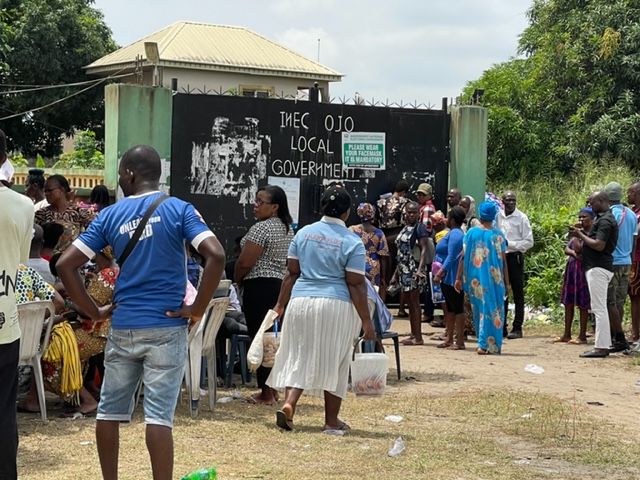
The Ojokoro LCDA office is located in street-ward facing flat on the first floor of this building. the sign post is the green one with white lettering
My first port of call was the Area Development Council office at Ojokoro where an attentive staff told me they were not aware of the situation and immediately put a call through to what he said was the phone number of the person in charge of matters of that nature in their LGA headquarters at Ifako/Ijaiye. With the person at Ifako/Ijaiye admitting that he was aware of the situation, having being informed by the police the day before, I asked what was holding them back from removing the body and was told that they were waiting for a police report before they can act.
Baffled by the dilly-dallying when hundreds of schoolchildren must have been exposed to the unflattering scene on their way to school and back, I thanked the helpful LGA officer and decided to check back with the police station. There, a visibly annoyed Mr Thomas expressed sadness that the body had not been removed even after he had expended his personal phone credits to get in touch with the person responsible in the Local Government office.
I left Alausa happy, envying the bags of Christmas rice that could be spied here and there, knowing that the chances of the body being moved was this time more closer than before.
Not that this justifies laxity, but as I left Alausa, I wondered at the crisp environment and the professional manner of the Lagos State Secretariat workers compared to the grimy, dilapidated nature of the police station and the local government office I went to before. I took one thing away; the working condition must surely play a role in how workers perform. The people at the SEHMO lived up to their promise as the body had already been removed by the time I passed that route on my way home later that evening.
The well groomed environment of the Lagos State Secretariat, Alausa
The promptness of the people from Alausa was a breath of fresh air, and a reaffirmation of the mantra that Lagos, even if only at the state government level, is working. However, one prays that something drastic is done about the way the citizens of Nigeria and the Government treat the dead. This is not just a call to heed the health implications of leaving animal and human corpses to rot on the streets, but also that we remember our culture and what should be human nature—respect for the dead, who, lacking the ability to HELP themselves, depend on us.
| Reactions: |
Tuesday, December 20, 2011
Book N Gauge: Filling a Literary Niche
It would not be farfetched to declare that the literary scene in Nigeria is on fire. There might not have been any corresponding reverse in the reading culture of Nigerians as it is – yet. However, the prevailing atmosphere within literary circles is one of itchy expectation, with an endless line of aspiring writers itching to find some form of relevance. Here, the internet, of course, has become a ready tool for the willing.
Years past, aspiring writers sent their works to the few newspapers and magazines that published works of that nature. This is usually done without recourse to any form of peer review and more often than not, the works are rejected, with the attendant knocks on the ego of the writers.
These days, things have changed, and drastically for the better too. The coming of the internet has provided avenues for savvy youths to meet, interact and coalesce into groups that are now driving Nigerian literary industry—yes, it is time we start calling it that and run it as such. These groups are revolutionising the way literary events and discussions are handled, causing even semi-retired old timers to crawl out of the woodwork and take notice.
While there are several groups with similar purpose, this article intends to highlight one of them, Book N Gauge.
Continue reading here
Years past, aspiring writers sent their works to the few newspapers and magazines that published works of that nature. This is usually done without recourse to any form of peer review and more often than not, the works are rejected, with the attendant knocks on the ego of the writers.
These days, things have changed, and drastically for the better too. The coming of the internet has provided avenues for savvy youths to meet, interact and coalesce into groups that are now driving Nigerian literary industry—yes, it is time we start calling it that and run it as such. These groups are revolutionising the way literary events and discussions are handled, causing even semi-retired old timers to crawl out of the woodwork and take notice.
While there are several groups with similar purpose, this article intends to highlight one of them, Book N Gauge.
Continue reading here
| Reactions: |
Wednesday, December 14, 2011
Amnesty Program: Kudos to President Jonathan
I am not one of President Goodluck Jonathan’s biggest fans. However, I now have reason to sing the man’s praise; albeit grudgingly.
The cause for which I must now sing GEJ’s praise is the amnesty program, or more significantly, that part of program that saw thousands of rustic Niger Delta youths (ex-militants if you like) attending human capacity development training programs in Nigeria and overseas.
Despite the negative news reports in the media about some unruly participants who found it hard to let go of their “jungle” ways even though they have literary been removed from the jungle, the facts from Amnesty Program insiders indicate that the youths in general conducted themselves exceptionally and were outstanding in training.
While some might suggest that I should have awaited the return of the “boys”, seen their effectiveness in the field, before calling their trip a success; I will humbly beg to disagree on the pretext that the echo of a big storm cannot be mistaken for a light shower; at least that was what I made of facts available to me and the comments of a staff of Trumps Consulting – one of the companies handling the Malaysian arm of the training program. The staff member said, “The only problem we had with the boys in our group is how fast they were learning. We had to add more to their curriculum as they exhausted the standardised training that was recommended for them.”
Now, that caught me off guard, especially as I have for long associated bloodletting, Indian hemp smoking and generally unruly behaviour to the “boys”.
Continue reading here
| Reactions: |
Sunday, December 11, 2011
Nigerians Brace for Tougher times
Back in May 2011 when President Goodluck Jonathan of Nigeria was being sworn in as president of Nigeria there was a palpable sense of anticipation that the Nigerian nation was back on the track of its much truncated quest for greatness, at least those who swore by the divine mandate of the president saw it thus.
Now, six months after that momentous day, the feeling of euphoria and hope for a new dawn has been replaced by something more ominous; the feeling of coming doom and failure to once again keep to the right track. This feeling is shared by both those who happily bought into the yarn about GEJ’s (as President Jonathan is referred to in Nigeria growing online media) heaven sent mandate and those who always believed the man is either too weak to lead a complex country like Nigeria, or too beholden to the corrupt puppet masters to do any good.
Much of the lack of confidence for the President and his team on the streets, homes and offices across Nigeria steams not from ill will over the election that brought the president to power or the usual ethnic and regional ill feelings that is synonymous with West Africa’s biggest economy, but as a direct result of what the President say is geared to advance the country, his economic blueprint.
Starting from January 2011, Nigerians have been told by the President and his economic team, led by World Bank top shot Ngozi Okonji-Iweala, that the all important subsidy on petroleum products would be removed, the toll gates across the nation’s highways – removed a few years ago during the presidency of Olusegun Obasanjo – will return, electricity tariffs will be increased and the Naira devalued (that has already happened, at least to an extent).
Aside from a bill to extend the presidential term by an additional 3 years, the foregoing is the sum of GEJ’s policy so far.
Looking at the main thrust of the economic team’s policy, which many Nigerians see as anti people, it is clear GEJ has fallen out of favour. Aside from the call for a single tenure of seven years, much of the policy statements by the GEJ administration are geared more towards reducing government spending and increasing inputs from the masses. While this is not in itself a bad thing, especially as Nigerian government spending is astronomically bloated by corrupt politicians and civil servants looking to enrich themselves, Nigerians say GEJ’s economic team is putting the cart before the horse.
Endless removal of oil subsidy
This is not the first time the issue of oil subsidy and its removal has brimmed at the surface of Nigerian national discuss and, like before, many Nigerians expect it to follow the path trod by its previous incarnations – into the “could have been” bag of politicians. The grouse is not with the oil subsidy removal, but with the lack of willingness by the government to tackle the issues that make removing it very controversial: the descript, non functional nature of much of the indigenous refineries that consigns Nigeria, Africa biggest petroleum exporter, to importing petroleum products, and the activities of the much vaunted cabal, with government connections, that inflate the subsidy and divert the massive overflow into their pockets and Swiss banks.
Reintroducing toll gates and the questions therein
“Why was the toll gates removed in the first place?” Nigerians ask.
The government reply, “Because the money being generated from them was not finding its way into government coffers and from there back to the roads where they would facilitate repairs and maintenance, but into the pockets of individuals.”
“But why not repair the roads first before tolling them?” Nigerians again ask. This time, they get no response, or as still waiting for response.
Paying more for even less electricity
The issue of power has for long been a key demand by the citizens to successive Nigerian governments; however, despite several promises and mega-millions sunk into making the industry viable, Nigerians still have to make do with power outages and blackouts. They are used to it, so much so that most households have generating sets that are the difference between staying in the dark or not, a situation that caused a Nigerian social commentator to quip “we have 160 million independent power producers”, a not so funny play at the country’s 160 million people.
The government says the increased tariff will encourage private entrepreneurs to invest in the sector; Nigerians say, improve the power supply before increasing tariffs.
In all, Nigerians say the government is missing the point, and that is, everything is tied together in Nigeria.
“If you increase the price of petroleum products, the price of every other goods and service will follow suit. Same thing goes for the increase in electricity tariff,” a Nigerian woman lamented.
While the government is insisting that the increments would be beneficial to Nigerians on the long run, the men on the street dread them, especially the hard times that they would usher in. The government is insisting on going forward, and if it gets its way, as many are predicting it will this time, Nigerians are sure to face serious tough times ahead. 
Labels:
Fuel Subsidy,
Hard Times,
Nigerian Corruption,
Nigerian election 2011,
Nigerian People,
Nigerian Politics
| Reactions: |
Subscribe to:
Posts (Atom)


